Did Mars Once Have an Ocean? New Evidence Points to a “Bathtub Ring”
Scientists uncover a possible coastal feature that may prove Mars once held a massive ocean billions of years ago.

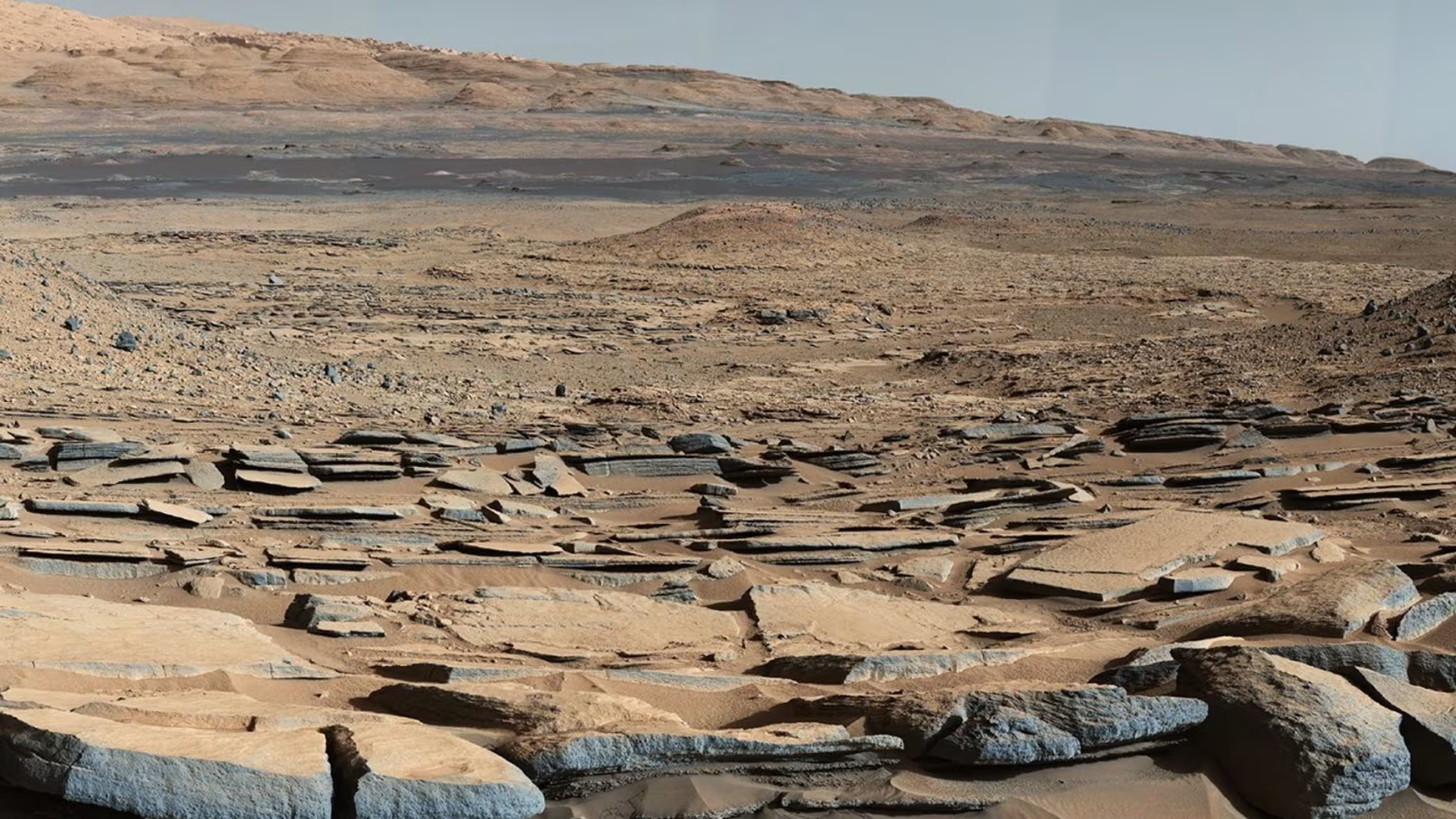
Scientists believe Mars may not have always been the cold, dry planet we see today. A new study suggests that billions of years ago, a massive ocean could have covered nearly one-third of its surface.
The strongest clue comes from what researchers describe as a “bathtub ring” — a wide, flat band of land that may mark the edge of an ancient ocean. This feature is similar to the continental shelves found on Earth, which form where land meets ocean.
To test their theory, scientists ran simulations showing how oceans disappear over time. Their results revealed that continental shelves remain one of the most stable and visible features, even after water vanishes. When they examined Mars data, they found signs of a similar structure, although not identical to Earth’s version.
The idea of water on Mars is not new. Previous missions have already discovered dried riverbeds, lake remnants, and mineral deposits that form in the presence of water. However, whether Mars once had a large, long-lasting ocean has remained a topic of debate among scientists.
Earlier evidence, such as suspected shorelines, has been questioned because the elevations were inconsistent. The newly proposed coastal shelf offers a more reliable indicator because it is wider, more durable, and less likely to be erased over time.
Additional support comes from other discoveries, including underground signs of ancient beaches and sediment deposits likely formed by flowing water. These findings suggest Mars once had an active water cycle, possibly including rivers feeding into a large ocean.
Despite these clues, scientists caution that the evidence is not yet definitive. Mars differs significantly from Earth, especially because it lacks plate tectonics — a key process that shapes Earth’s oceans and continents. This makes direct comparisons challenging.
Future missions could provide clearer answers. The upcoming European rover, Rosalind Franklin, is expected to explore regions where this ancient ocean may have existed, using advanced tools to analyze both surface and subsurface materials.
Confirming the existence of a Martian ocean would be a major breakthrough. It could reshape our understanding of the planet’s climate history and strengthen the possibility that Mars once supported life.
For now, the mystery remains open — but with each discovery, scientists are getting closer to answering one of humanity’s biggest questions: Was Mars ever truly a living world?
News You Should See
P&G Raises Fiscal 2027 Cost Warning as Oil and Freight Expenses Threaten Profits
Chemical Tank Leak in Toledo Triggers Evacuations and Industrial Disruptions
Judge Sets December 11 Deadline for Trump Deposition in BBC Defamation Case
Iowa Senate Race Tests How Far Republicans Can Separate Themselves From Trump
California State Workers Strike Over Pay, Healthcare and Return-to-Office Rules
Streaming’s October Showdown: How Disney, Netflix and Major Entertainment Brands Compete for Audiences
Latest News
Procter & Gamble expects commodity, energy and transportation costs to reduce fiscal 2027 profit by $1.4 billion. Quarterly sales rose 4% to $23.28 billion, beating analyst expectations.
A ruptured chemical tank in Toledo, Ohio, prompted evacuations, school closures and an industrial shutdown. Authorities have reduced the restricted zone as the release slows and cleanup preparations continue.
A federal judge has ordered Donald Trump to give a deposition by December 11, 2026, in his $10 billion lawsuit against the BBC, with possible sanctions for noncompliance as the discovery deadline approaches.
Iowa’s 2026 Senate race pits Republican Ashley Hinson, balancing Trump support with economic concerns, against Democrat Josh Turek, who emphasizes bipartisanship amid rising campaign spending.
Thousands of California state workers struck on October 21 over a proposed three-year pay increase, healthcare costs and a four-day office attendance requirement as contract negotiations continued.
October 2026 brings major entertainment releases across Disney+, Netflix, HBO Max, Hulu, Prime Video and Peacock. Explore how familiar franchises, exclusive programming, new music and video games shape competition for streaming audiences.
Saudia advises travelers to book flights through Al Qassim Airport for Riyadh connections, offering free hourly shuttle buses in both directions until further notice.
An AP-NORC poll shows Democratic confidence in accurate vote counting falling to 55%, while Republican confidence rises to 38%, highlighting election integrity concerns ahead of the 2026 US midterms.
Donald Trump campaigns in North Carolina ahead of the November 2026 midterms as low approval ratings, rising fuel costs, Democratic early-voting gains and funding disparities challenge Republican efforts to retain control of Congress.