Storms from the Deep: How Hurricanes Feed Life in the Ocean
Discover how seabirds like the Desertas petrel thrive in hurricane chaos, feeding on creatures stirred from the deep.

Storms from the Deep
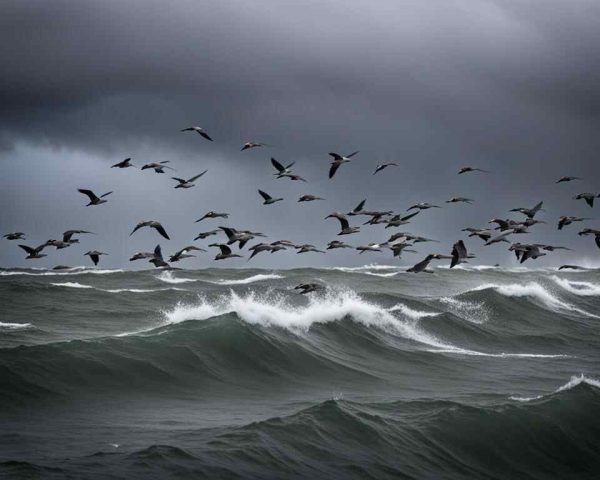
When hurricanes sweep across the ocean, they don’t just stir up the atmosphere—they also churn the waters below, dragging creatures from the deep closer to the surface. For some predators, especially those that can withstand the chaos, this presents a rare and bountiful opportunity to feed.
A Bird on a Cliff
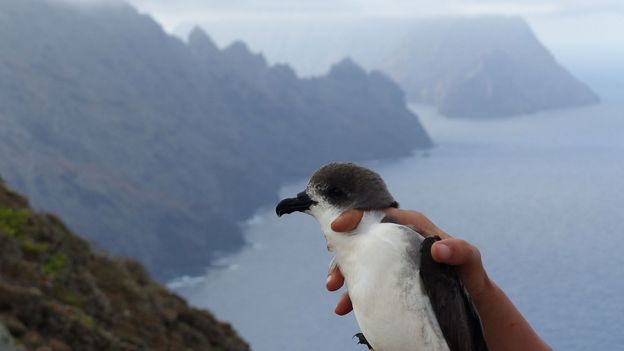
High on a remote rocky plateau, a small nocturnal seabird rests in its burrow. Far below, waves touch the base of the cliffs. Though the night is calm, the bird seems to sense something stirring far out to sea—about 1,000 miles off the coast of Morocco, a storm is forming. Fueled by warm ocean waters, the tropical cyclone builds into a powerful, rotating force. It grows to span hundreds of miles, with lightning flashing across its outer bands and winds reaching 150 miles per hour. These winds stir the ocean, creating swells and turbulence that reach deep beneath the surface.
Hurricane Responses
Hurricanes are typically associated with destruction. Seabirds often respond by halting foraging trips and sheltering ashore, or flying great distances to avoid the danger. Some birds, like frigatebirds, soar to high altitudes to pass quickly above storms. Even albatrosses, birds that thrive in strong winds, may seek out the calm center of a cyclone for temporary safety.
Opportunity in Chaos
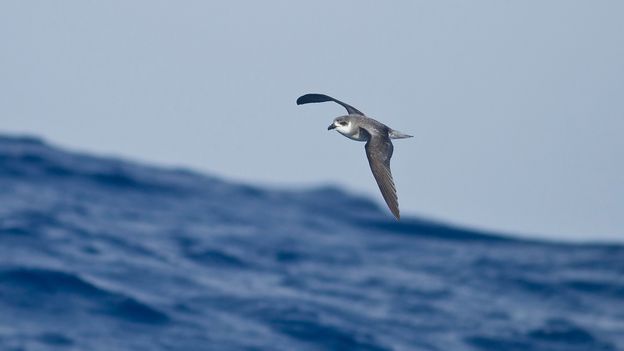
Yet not all animals view these storms as threats. For some, they bring opportunity. As hurricanes disturb the sea, creatures that normally dwell hundreds of meters below—such as squid, octopus, and cuttlefish—are pulled closer to the surface. One bird in particular, the Desertas petrel, seems to have evolved to exploit this moment. Small and agile, with long, slender wings, this bird is drawn to the heart of the storm rather than repelled by it. It flies directly into the turbulent bands of the cyclone, approaching within 200 kilometers of the eye.
Into the Storm
Biologist Francesco Ventura, a postdoctoral researcher at the Woods Hole Oceanographic Institution, is one of the scientists studying these birds. He describes the conditions the petrels endure as nearly unimaginable. Though only the size of a pigeon and weighing just a few hundred grams, they fly through winds likely exceeding 100 kilometers per hour and over ocean swells as tall as 8 meters. Amid this chaos, the birds follow a calculated path. When the cyclone passes, the petrels align their route along the storm’s wake, where prey has been stirred up and brought to the surface.
Hurricanes Below the Surface
Hurricanes impact the ocean in profound ways. They disrupt coastal and marine ecosystems, stir the seabed, destroy turtle nesting sites, scatter migrating species, and damage coral reefs. Yet they also create new opportunities for life by forcing warm surface water downward and drawing cold, nutrient-rich water from the deep to the surface. This upwelling sparks blooms of phytoplankton, the microscopic algae that form the foundation of the oceanic food chain. Zooplankton come to feed on the phytoplankton, and in turn attract fish and deep-sea creatures from the ocean’s twilight zone. All of this activity provides an abundance of prey for surface-feeding seabirds like the Desertas petrel.
The Storm-Born Seabird
This species, native to the North Atlantic, breeds on the island of Bugio in the rugged Desertas chain, part of the Madeiran archipelago. Their breeding season coincides with the Atlantic hurricane season—a timing that might seem risky, but reflects their evolutionary history. They belong to a group of seabirds long associated with stormy seas. Despite being difficult to observe at sea, there were hints about their behavior from sailors and fishermen who reported sightings of them far from land.
Unlocking Secrets
In 2015, Ventura and colleagues set out to learn more about the lives of these elusive birds. Reaching their nesting grounds required a challenging climb up steep cliffs to a remote plateau filled with burrows. At night, the island comes alive with the eerie sounds of birds calling from underground and swooping through the dark sky. The setting only added to the mystique that had long surrounded the species.
Epic Journeys
Researchers attached lightweight GPS trackers to the birds and waited for them to return from their foraging trips. When the birds came back, the data revealed an astonishing picture. Some petrels had flown more than 12,000 kilometers in a single trip, crossing the Atlantic from Africa to the New England coast and back. Even more surprising, they deliberately intersected with hurricanes.
Chasing Storms
Over four breeding seasons between 2015 and 2019, Ventura’s team tracked 33 birds on 43 foraging trips. They found that when a hurricane was located up to 900 kilometers away, the birds chose flight paths that brought them closer to the storm’s eye. Rather than avoiding these massive weather systems, the petrels approached them, entered the outer regions, and then followed their wake across the ocean for days at a time.
Masters of the Wind
Desertas petrels are opportunistic hunters. Their long-range journeys and unique flying style—called dynamic soaring—allow them to harvest energy from changing wind speeds and directions. By gliding between slow and fast air layers, they conserve energy while covering immense distances. Their wings, long and narrow, give them a high aspect ratio and minimal drag, making them exceptionally efficient in flight.
Natural Navigators
These birds appear to have a detailed understanding of the Atlantic’s wind systems. They navigate based on the predictable patterns of prevailing winds and respond to large-scale atmospheric changes with astonishing precision. As hurricanes pass, researchers observed a drop in sea surface temperature and an increase in chlorophyll, indicating a phytoplankton bloom. This triggers a chain reaction, drawing zooplankton, then deep-sea species like squid and lanternfish, which rise to the surface at night—just when the petrels are foraging.
Winners and Losers
But while some species benefit from stormy conditions, others suffer. Many seabirds that are not adapted to these conditions are forced off course and struggle to find food. One notable incident occurred between December 2013 and February 2014, when nearly 60,000 dead seabirds were found along the coasts of northwestern Europe after winter storms. Most had died of starvation.
Sensing the Season
Even land birds are affected. The Veery, a small songbird, appears to anticipate intense hurricane seasons. A 2018 study found that in years with more severe storms, these birds laid fewer eggs and left their nests earlier. The exact mechanism behind this behavior is still unknown, though scientists speculate it could be linked to changes in rainfall, food availability, or even atmospheric dust from the Sahara reaching South America.
Life in the Wake
Back in the Atlantic, as hurricanes like Imelda and Humberto send swells across the ocean, Desertas petrels may already be soaring along their paths, feasting on prey drawn to the surface. While hurricanes are often associated with destruction, they also bring dramatic change to ocean life. For creatures like the Desertas petrel, they offer a fleeting yet vital opportunity—a window of abundance in a vast, often barren sea.
Adapting to Extremes
According to Ventura, although the impacts of hurricanes are devastating for many species, they occur within a specific season. Over time, certain animals have evolved to not only survive these extremes but to exploit them. Even now, he suggests, some petrels may be out over the ocean, chasing the wake of a storm, riding the winds, and feeding on life churned up from the deep. It’s a wild and little-understood interaction, but one that speaks to the resilience and adaptability of life in even the harshest corners of our planet.
News You Should See
P&G Raises Fiscal 2027 Cost Warning as Oil and Freight Expenses Threaten Profits
Chemical Tank Leak in Toledo Triggers Evacuations and Industrial Disruptions
Judge Sets December 11 Deadline for Trump Deposition in BBC Defamation Case
Iowa Senate Race Tests How Far Republicans Can Separate Themselves From Trump
California State Workers Strike Over Pay, Healthcare and Return-to-Office Rules
Streaming’s October Showdown: How Disney, Netflix and Major Entertainment Brands Compete for Audiences
Latest News
Procter & Gamble expects commodity, energy and transportation costs to reduce fiscal 2027 profit by $1.4 billion. Quarterly sales rose 4% to $23.28 billion, beating analyst expectations.
A ruptured chemical tank in Toledo, Ohio, prompted evacuations, school closures and an industrial shutdown. Authorities have reduced the restricted zone as the release slows and cleanup preparations continue.
A federal judge has ordered Donald Trump to give a deposition by December 11, 2026, in his $10 billion lawsuit against the BBC, with possible sanctions for noncompliance as the discovery deadline approaches.
Iowa’s 2026 Senate race pits Republican Ashley Hinson, balancing Trump support with economic concerns, against Democrat Josh Turek, who emphasizes bipartisanship amid rising campaign spending.
Thousands of California state workers struck on October 21 over a proposed three-year pay increase, healthcare costs and a four-day office attendance requirement as contract negotiations continued.
October 2026 brings major entertainment releases across Disney+, Netflix, HBO Max, Hulu, Prime Video and Peacock. Explore how familiar franchises, exclusive programming, new music and video games shape competition for streaming audiences.
Saudia advises travelers to book flights through Al Qassim Airport for Riyadh connections, offering free hourly shuttle buses in both directions until further notice.
An AP-NORC poll shows Democratic confidence in accurate vote counting falling to 55%, while Republican confidence rises to 38%, highlighting election integrity concerns ahead of the 2026 US midterms.
Donald Trump campaigns in North Carolina ahead of the November 2026 midterms as low approval ratings, rising fuel costs, Democratic early-voting gains and funding disparities challenge Republican efforts to retain control of Congress.