Supreme Court Declines Gwynne Wilcox Case, Strengthening Trump’s Power Over Labor Board
The Supreme Court’s refusal to review Gwynne Wilcox’s dismissal leaves in place a ruling favoring President Donald Trump and intensifies the debate over the independence of federal regulatory agencies.

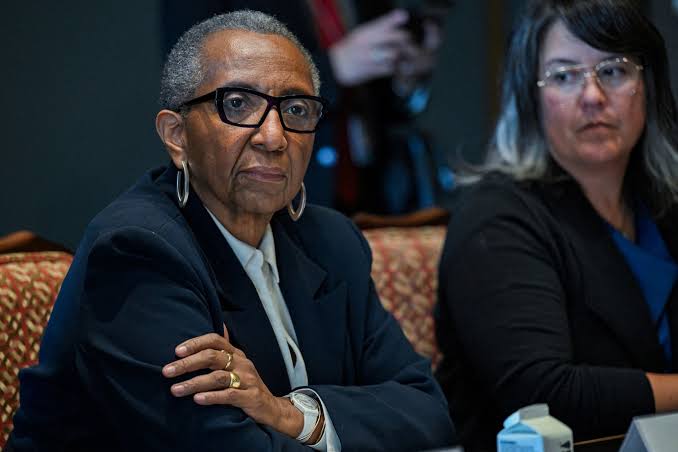
The U.S. Supreme Court has declined to review the dismissal of Gwynne Wilcox from the National Labor Relations Board, leaving in place a lower-court decision that supports President Donald Trump’s authority to remove members of federal agencies. The move adds to a series of legal developments reshaping the relationship between the White House and regulatory bodies designed to operate with a degree of independence from the executive branch.
Wilcox, the first Black woman to serve on the National Labor Relations Board, was appointed to a second term by former President Joe Biden. Trump dismissed her in January 2025, approximately one week after beginning his second term. Her legal challenge centered on federal legislation that she argued protected board members from removal without cause.
A district court initially ruled in Wilcox’s favor. That decision was overturned by the U.S. Court of Appeals for the District of Columbia Circuit in December 2025, allowing the dismissal to stand. The Supreme Court’s refusal to take up her appeal leaves the appellate ruling in place without a new decision on the merits of her individual claims.
The outcome reflects a broader shift in the legal framework governing independent federal agencies. In June 2026, the Supreme Court backed Trump’s removal of former Federal Trade Commission member Rebecca Slaughter, in a decision that weakened longstanding protections against dismissals without cause. The latest development involving Wilcox reinforces the practical implications of that direction for agencies responsible for workplace regulation and other areas of economic oversight.
The National Labor Relations Board plays a central role in administering federal labor law. It oversees union representation elections, investigates allegations of unfair labor practices and adjudicates disputes between employers, workers and labor organizations. Its decisions can affect collective bargaining, workplace policies, labor costs and the legal risks businesses face when managing their workforces.
For companies, the question of who controls the board is more than a matter of political appointments. The composition of the agency can influence its enforcement priorities, the interpretation of labor protections and the regulatory environment in which employers make hiring, restructuring and investment decisions. Changes in leadership may also affect how businesses assess the risks associated with union organizing and labor disputes.
The dispute therefore has implications for both employers and employees. Businesses may welcome greater presidential influence if it leads to regulatory priorities that align with the administration's economic agenda. However, frequent changes in agency leadership and uncertainty over the durability of regulatory decisions can make compliance planning more difficult, particularly for companies operating across multiple states or industries.
For workers and unions, the case raises concerns about the continuity of labor protections and the ability of an independent board to make decisions without direct political pressure. If future administrations can more readily replace agency members, enforcement priorities could shift more sharply after elections, potentially creating a less predictable framework for collective bargaining and workplace disputes.
The ruling also matters for the institutional identity of federal agencies. Congress established independent commissions partly to create a measure of continuity between administrations, allowing officials to exercise statutory responsibilities without being entirely dependent on the president's preferences. A broader presidential removal power could change how these institutions operate, how their leaders approach contested decisions and how much confidence regulated parties place in their long-term consistency.
At the same time, the administration's position reflects a different interpretation of executive accountability: a president should have greater authority over officials exercising power within the executive branch. Supporters of this approach argue that elected leadership should be able to direct government policy and hold agency officials accountable. Critics warn that reducing statutory safeguards could expose regulatory decisions to greater political influence.
The Supreme Court's refusal to review Wilcox's case does not, by itself, settle every question about the permissible removal of officials across the federal government. The legal treatment of different agencies can depend on their statutory structures, responsibilities and the applicable precedents. Nevertheless, the decision leaves a significant appellate ruling intact and adds to the pressure on the traditional model of independent regulatory oversight.
For businesses, the longer-term effect will depend on how these legal principles translate into agency appointments, enforcement policies and future litigation. Companies may need to monitor changes in labor regulation more closely, assess the potential effects of shifting enforcement priorities and avoid assuming that current administrative interpretations will remain stable across presidential terms.
The broader issue extends beyond one dismissal. The balance between presidential control and independent regulatory decision-making helps determine how consistently federal rules are applied, how disputes are resolved and how businesses and workers plan for the future. As the boundaries of executive authority continue to evolve, the independence of the National Labor Relations Board and similar agencies will remain an important factor in the U.S. regulatory and labor landscape.
News You Should See
P&G Raises Fiscal 2027 Cost Warning as Oil and Freight Expenses Threaten Profits
Chemical Tank Leak in Toledo Triggers Evacuations and Industrial Disruptions
Judge Sets December 11 Deadline for Trump Deposition in BBC Defamation Case
Iowa Senate Race Tests How Far Republicans Can Separate Themselves From Trump
California State Workers Strike Over Pay, Healthcare and Return-to-Office Rules
Streaming’s October Showdown: How Disney, Netflix and Major Entertainment Brands Compete for Audiences
Latest News
Procter & Gamble expects commodity, energy and transportation costs to reduce fiscal 2027 profit by $1.4 billion. Quarterly sales rose 4% to $23.28 billion, beating analyst expectations.
A ruptured chemical tank in Toledo, Ohio, prompted evacuations, school closures and an industrial shutdown. Authorities have reduced the restricted zone as the release slows and cleanup preparations continue.
A federal judge has ordered Donald Trump to give a deposition by December 11, 2026, in his $10 billion lawsuit against the BBC, with possible sanctions for noncompliance as the discovery deadline approaches.
Iowa’s 2026 Senate race pits Republican Ashley Hinson, balancing Trump support with economic concerns, against Democrat Josh Turek, who emphasizes bipartisanship amid rising campaign spending.
Thousands of California state workers struck on October 21 over a proposed three-year pay increase, healthcare costs and a four-day office attendance requirement as contract negotiations continued.
October 2026 brings major entertainment releases across Disney+, Netflix, HBO Max, Hulu, Prime Video and Peacock. Explore how familiar franchises, exclusive programming, new music and video games shape competition for streaming audiences.
Saudia advises travelers to book flights through Al Qassim Airport for Riyadh connections, offering free hourly shuttle buses in both directions until further notice.
An AP-NORC poll shows Democratic confidence in accurate vote counting falling to 55%, while Republican confidence rises to 38%, highlighting election integrity concerns ahead of the 2026 US midterms.
Donald Trump campaigns in North Carolina ahead of the November 2026 midterms as low approval ratings, rising fuel costs, Democratic early-voting gains and funding disparities challenge Republican efforts to retain control of Congress.