Trump’s North Carolina Campaign Tests Republican Strategy as Midterm Risks Mount
With record-low approval ratings, rising fuel concerns and Democratic gains, Trump is using campaign rallies, industrial investments and financial promises to protect Republican control of Congress.

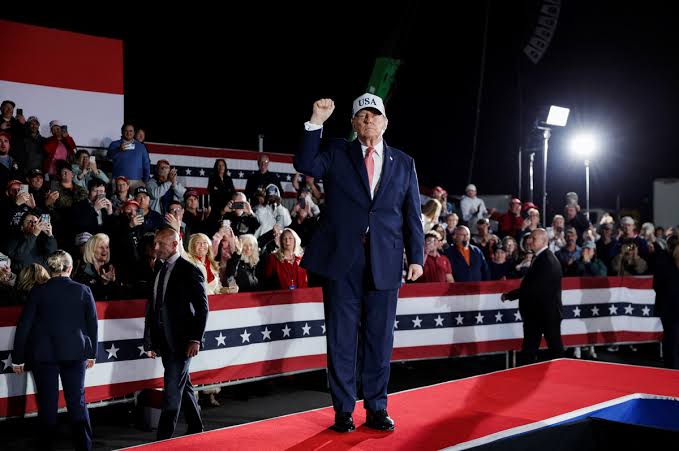
President Donald Trump’s campaign appearance in Greenville, North Carolina, on October 20 placed one of the Republican Party’s most consequential electoral challenges under the spotlight. With the November 3 midterm elections approaching, Trump is attempting to turn his personal popularity among loyal supporters into a broader advantage for Republican candidates, even as national polling and local voting patterns suggest that the party faces a difficult contest.
The president has traveled more than 29,000 miles since late September to support Republicans, returning to North Carolina for a second visit in as many months. His decision to devote significant campaign attention to the state reflects its importance in determining congressional control. Yet the political conditions surrounding the visit reveal a central weakness in the Republican strategy: the ability to generate enthusiasm at rallies does not necessarily translate into sufficient support among voters concerned about household finances and the administration’s policy decisions.
Trump’s approval rating has fallen to 31%, its lowest point across his two presidential terms, according to a Reuters/Ipsos survey. Economic dissatisfaction has become a particularly difficult issue for the administration. The survey found that 68% of Americans disapproved of Trump’s handling of the economy, including 37% of respondents identifying as Republicans. Rising gasoline and diesel prices following US and Israeli strikes on Iran in February have added pressure to household budgets and complicated the administration’s efforts to present its economic record favorably.
For the Republican Party, the problem is both political and strategic. A campaign centered on Trump can mobilize voters who remain strongly committed to him, but it also risks making local candidates accountable for national controversies and economic grievances. In closely contested districts, candidates must persuade voters who may support Republican policies in principle but are dissatisfied with the costs of living or the administration’s performance.
North Carolina’s Senate race illustrates the consequences. Former Democratic Governor Roy Cooper holds a substantial polling advantage over Republican Michael Whatley, a former senior party official. The contest is for the seat being vacated by Republican Senator Thom Tillis, who has expressed pessimism about his party’s prospects and previously clashed with Trump over major tax legislation and defense policy. The disagreements demonstrate that the challenge facing Republicans is not limited to competition with Democrats; divisions within their own political ranks can also complicate campaign messaging and party coordination.
The financial structure of the race presents another obstacle. The Senate Leadership Fund, a major political action committee supporting Republican Senate candidates, halted spending in North Carolina earlier in October after Cooper maintained double-digit leads in successive polls. With a major source of national financial support withdrawn, Whatley faces a more difficult path in competing against a Democratic challenger who has established a strong position in the polls.
Campaign finance has become particularly consequential in the state’s House contests. Republicans currently hold 10 of North Carolina’s 14 seats in the House of Representatives, but several districts are competitive. The race between Trump-backed Republican Laurie Buckhout and Democratic Representative Don Davis attracted $21 million in outside spending from September 1 onward, making it the country’s third-most-expensive congressional contest, according to an analysis of campaign filings. In western North Carolina, outside groups spent $14.5 million on the contest between Democrat Jamie Ager and Republican Jennifer Balkcom.
These figures show how political resources are concentrated in races where relatively small shifts in voter behavior could influence the national balance of power. Money can finance advertising, direct voter contact and turnout operations, but it cannot guarantee that voters will respond to a campaign’s message. The decision to withdraw support from Whatley also illustrates how national political organizations may redirect resources when polling suggests that the probability of winning has diminished.
Early voting adds to the pressure. State data showed that Democrats had cast ballots at twice the rate of Republicans at the time of Trump’s rally. That gap is not a final forecast, because turnout can change as Election Day approaches and different groups participate at different stages. It nevertheless creates an immediate organizational challenge for Republican campaigns: they must convert expressions of support into actual votes and ensure that their supporters do not postpone participation until the final day.
Trump’s response has included an effort to connect his political message with investment and industrial development. During the Greenville event, Commerce Secretary Howard Lutnick announced that Sibelco, a company specializing in industrial minerals mining and processing, was expanding its North Carolina operations. No specific details about the scale or timing of the expansion were provided during the announcement, and the company did not immediately respond to a request for comment.
Trump also said the US Defense Department would invest $1.5 billion in semiconductor chip production in North Carolina. He did not identify the locations involved or explain how the money would be allocated. Semiconductor manufacturing is strategically important to the United States because chips underpin consumer electronics, computing systems and defense technologies. Investments that strengthen domestic production could support industrial suppliers and specialized employment, while reducing some vulnerabilities in critical supply chains.
The economic significance of the announcement, however, will depend on implementation rather than the headline figure alone. Details about project ownership, financing, construction schedules, production capacity and job creation are necessary to assess the likely effect on the state’s economy. Without those details, the announcement signals an intended industrial priority but does not yet establish the scale of the resulting economic benefits.
This distinction matters politically because the economic experiences of households often move at a different pace from industrial investment. New manufacturing capacity takes time to build and can require years to reach full production. Higher fuel prices, by contrast, affect transport, distribution and household spending almost immediately. For an administration seeking to defend its economic record, the challenge is to show how long-term investment plans will translate into tangible improvements in living standards.
Trump also repeated a pledge to give $5,000 to every US adult if Republicans retain control of Congress. He did not explain at the rally how the payments would be financed or implemented. The proposal makes a direct financial benefit part of the electoral argument, linking the promise to the outcome of the congressional elections. Its feasibility remains dependent on the funding arrangements and the legal and legislative steps required to put such a program into effect.
Taken together, the campaign’s central elements reveal an attempt to address several weaknesses at once: personal campaigning to strengthen turnout, industrial announcements to demonstrate economic progress, and financial promises to appeal to voters concerned about affordability. Yet each approach faces a different test. Rally attendance does not establish electoral support, investment announcements require measurable follow-through, and proposed payments need a credible implementation plan.
The November 3 election will determine whether Trump’s personal involvement can help Republicans overcome the pressures evident in North Carolina and other competitive contests. The outcome will affect not only the balance of power in Congress but also the administration’s ability to advance its legislative agenda. North Carolina therefore represents more than a regional campaign stop: it is a test of whether a strategy built around presidential influence can withstand economic dissatisfaction, uneven campaign resources and changing voter participation.
News You Should See
P&G Raises Fiscal 2027 Cost Warning as Oil and Freight Expenses Threaten Profits
Chemical Tank Leak in Toledo Triggers Evacuations and Industrial Disruptions
Judge Sets December 11 Deadline for Trump Deposition in BBC Defamation Case
Iowa Senate Race Tests How Far Republicans Can Separate Themselves From Trump
California State Workers Strike Over Pay, Healthcare and Return-to-Office Rules
Streaming’s October Showdown: How Disney, Netflix and Major Entertainment Brands Compete for Audiences
Latest News
Procter & Gamble expects commodity, energy and transportation costs to reduce fiscal 2027 profit by $1.4 billion. Quarterly sales rose 4% to $23.28 billion, beating analyst expectations.
A ruptured chemical tank in Toledo, Ohio, prompted evacuations, school closures and an industrial shutdown. Authorities have reduced the restricted zone as the release slows and cleanup preparations continue.
A federal judge has ordered Donald Trump to give a deposition by December 11, 2026, in his $10 billion lawsuit against the BBC, with possible sanctions for noncompliance as the discovery deadline approaches.
Iowa’s 2026 Senate race pits Republican Ashley Hinson, balancing Trump support with economic concerns, against Democrat Josh Turek, who emphasizes bipartisanship amid rising campaign spending.
Thousands of California state workers struck on October 21 over a proposed three-year pay increase, healthcare costs and a four-day office attendance requirement as contract negotiations continued.
October 2026 brings major entertainment releases across Disney+, Netflix, HBO Max, Hulu, Prime Video and Peacock. Explore how familiar franchises, exclusive programming, new music and video games shape competition for streaming audiences.
Saudia advises travelers to book flights through Al Qassim Airport for Riyadh connections, offering free hourly shuttle buses in both directions until further notice.
An AP-NORC poll shows Democratic confidence in accurate vote counting falling to 55%, while Republican confidence rises to 38%, highlighting election integrity concerns ahead of the 2026 US midterms.
Donald Trump campaigns in North Carolina ahead of the November 2026 midterms as low approval ratings, rising fuel costs, Democratic early-voting gains and funding disparities challenge Republican efforts to retain control of Congress.